Executive Engineering Brief
A scalable four-stroke industrial power platform
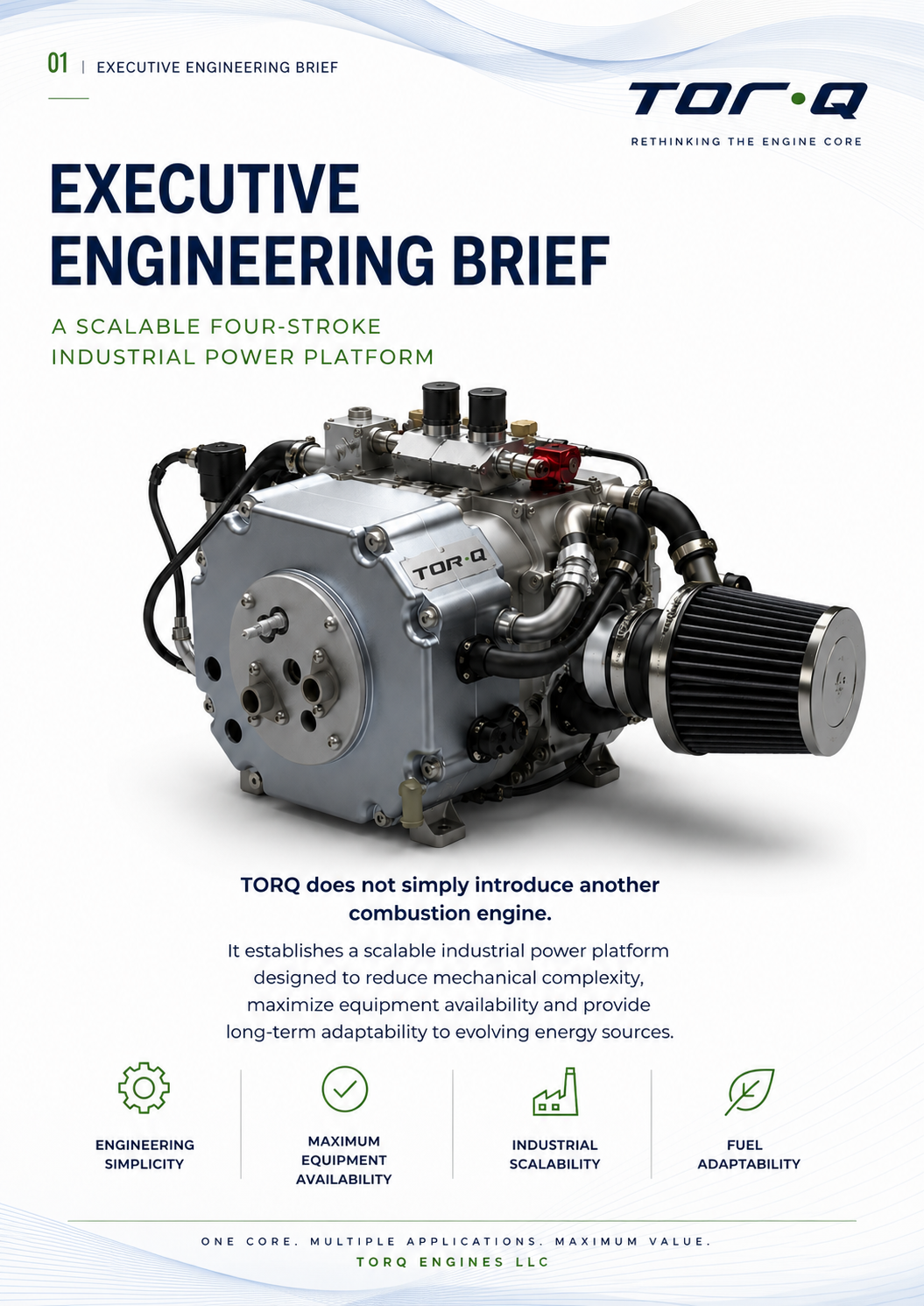
TORQ does not simply introduce another combustion engine.
It establishes a scalable industrial power platform designed to reduce mechanical complexity, maximize equipment availability and provide long-term adaptability to evolving energy sources.
- Engineering simplicity
- Maximum equipment availability
- Industrial scalability
- Fuel adaptability
02 — Engine architecture
A new approach to the four-stroke cycle
TORQ introduces a patented rotative architecture that preserves the proven four-stroke thermodynamic cycle while eliminating the crankshaft, connecting rods and the cylinder head assembly with all its subcomponents.
By eliminating the cylinder head assembly and connecting rods, TORQ achieves a naturally balanced architecture with significantly reduced vibration levels and lower mechanical complexity.
Balanced rotary architecture
- Naturally balanced rotary mechanism
- Significantly reduced vibration levels
- No cylinder head or head gasket
- No connecting rods
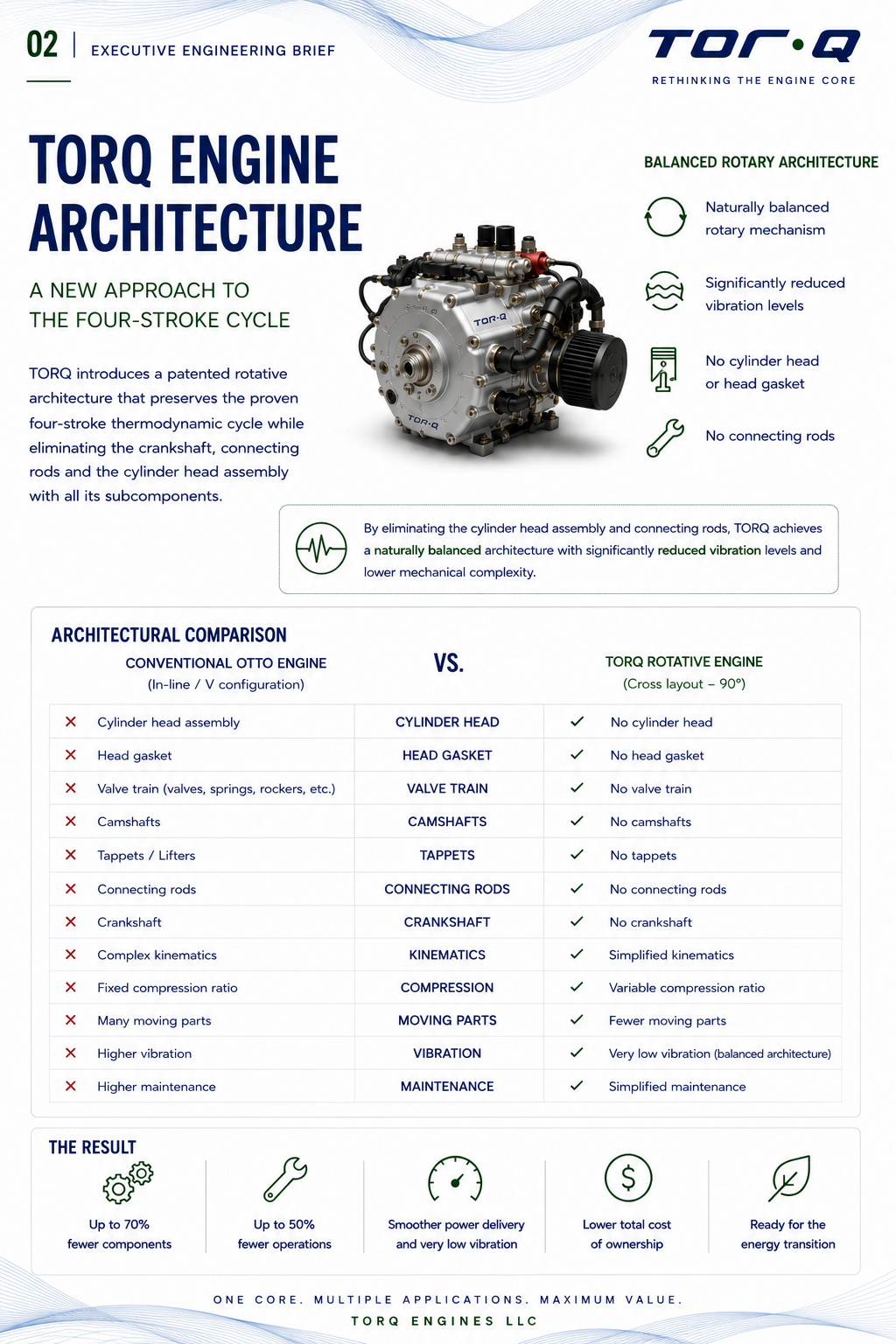
Architectural comparison
Conventional Otto engine
In-line / V configuration
TORQ rotative engine
Cross layout — 90°
Cylinder head
Cylinder head assemblyCylinder headNo cylinder headHead gasket
Head gasketHead gasketNo head gasketValve train
Valves, springs, rockersValve trainNo valve trainCamshafts
CamshaftsCamshaftsNo camshaftsTappets
Tappets / liftersTappetsNo tappetsConnecting rods
Connecting rodsConnecting rodsNo connecting rodsCrankshaft
CrankshaftCrankshaftNo crankshaftKinematics
Complex kinematicsKinematicsSimplified kinematicsCompression
Fixed compression ratioCompressionVariable compression ratioMoving parts
Many moving partsMoving partsFewer moving partsVibration
Higher vibrationVibrationVery low vibrationMaintenance
Higher maintenanceMaintenanceSimplified maintenance
The result
- Up to 70% fewer components
- Up to 50% fewer operations
- Smoother power delivery and very low vibration
- Lower total cost of ownership
- Ready for the energy transition
03 — Engineering simplicity by design
Engineering simplicity by design
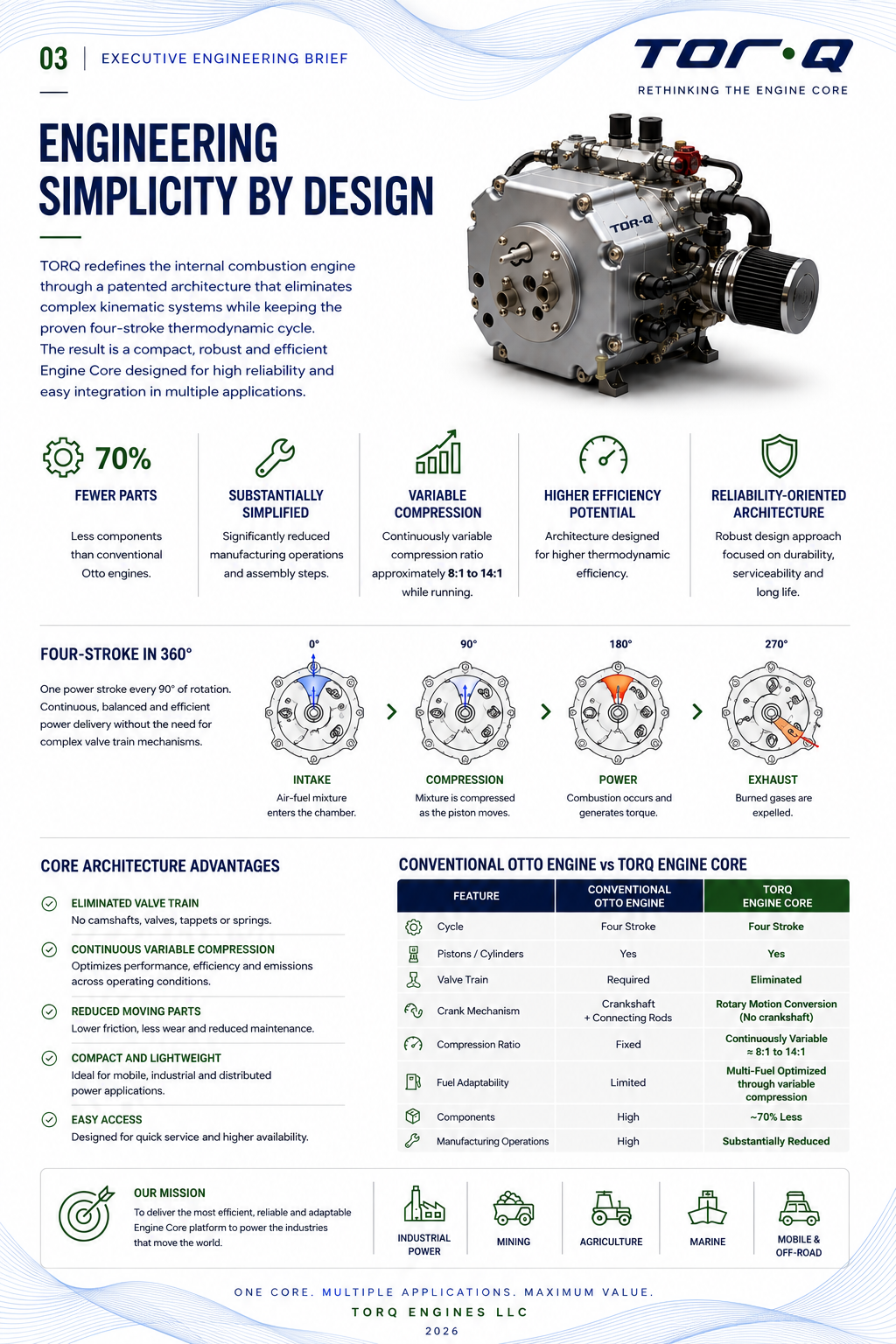
TORQ redefines the internal combustion engine through a patented architecture that eliminates complex kinematic systems while keeping the proven four-stroke thermodynamic cycle. The result is a compact, robust and efficient Engine Core designed for high reliability and easy integration in multiple applications.
- 70%
- Fewer parts
Less components than conventional Otto engines.
- 50%
- Substantially simplified
Significantly reduced manufacturing operations and assembly steps.
- 8:1–14:1
- Variable compression
Continuously variable compression ratio while running.
- 360°
- Higher efficiency potential
Architecture designed for higher thermodynamic efficiency.
Four-stroke in 360°
One power stroke every 90° of rotation. Continuous, balanced and efficient power delivery without the need for complex valve train mechanisms.
- 0°
Intake
Air-fuel mixture enters the chamber.
- 90°
Compression
Mixture is compressed as the piston moves.
- 180°
Power
Combustion occurs and generates torque.
- 270°
Exhaust
Burned gases are expelled.
Intake Air-fuel mixture enters the chamber.
Core architecture advantages
Eliminated valve train
No camshafts, valves, tappets or springs.
Continuous variable compression
Optimizes performance, efficiency and emissions across operating conditions.
Reduced moving parts
Lower friction, less wear and reduced maintenance.
Compact and lightweight
Ideal for mobile, industrial and distributed power applications.
Easy access
Designed for quick service and higher availability.
Conventional Otto engine vs TORQ Engine Core
Cycle
- Conventional Otto engine
- Four stroke
- TORQ Engine Core
- Four stroke
Pistons / cylinders
- Conventional Otto engine
- Yes
- TORQ Engine Core
- Yes
Valve train
- Conventional Otto engine
- Required
- TORQ Engine Core
- Eliminated
Crank mechanism
- Conventional Otto engine
- Crankshaft + connecting rods
- TORQ Engine Core
- Rotary motion conversion
Compression ratio
- Conventional Otto engine
- Fixed
- TORQ Engine Core
- Continuously variable ≈ 8:1 to 14:1
Fuel adaptability
- Conventional Otto engine
- Limited
- TORQ Engine Core
- Multi-fuel through variable compression
Components
- Conventional Otto engine
- High
- TORQ Engine Core
- ~70% less
Manufacturing operations
- Conventional Otto engine
- High
- TORQ Engine Core
- Substantially reduced
Our mission
To deliver the most efficient, reliable and adaptable Engine Core platform to power the industries that move the world.
- Industrial power
- Mining
- Agriculture
- Marine
- Mobile & off-road
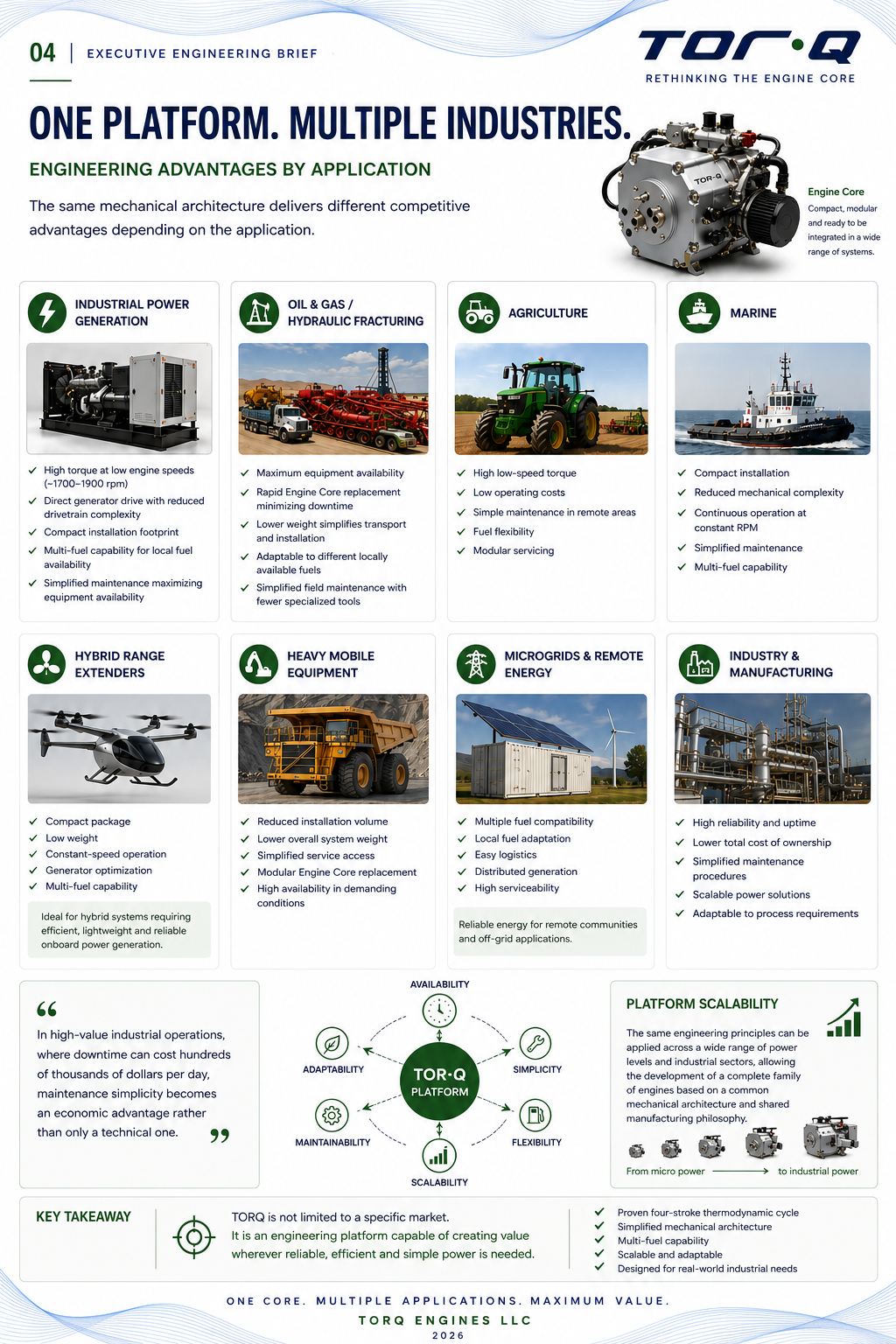
04 — One platform. Multiple industries.
One platform. Multiple industries.
Engineering advantages by application
The same mechanical architecture delivers different competitive advantages depending on the application.
Industrial power generation
- High torque at low engine speeds (~1700–1900 rpm)
- Direct generator drive with reduced drivetrain complexity
- Compact installation footprint
- Multi-fuel capability for local fuel availability
- Simplified maintenance maximizing equipment availability
Oil & gas / hydraulic fracturing
- Maximum equipment availability
- Rapid Engine Core replacement minimizing downtime
- Lower weight simplifies transport and installation
- Adaptable to different locally available fuels
- Simplified field maintenance with fewer specialized tools
Agriculture
- High low-speed torque
- Low operating costs
- Simple maintenance in remote areas
- Fuel flexibility
- Modular servicing
Marine
- Compact installation
- Reduced mechanical complexity
- Continuous operation at constant RPM
- Simplified maintenance
- Multi-fuel capability
Hybrid range extenders
- Compact package
- Low weight
- Constant-speed operation
- Generator optimization
- Multi-fuel capability
Ideal for hybrid systems requiring efficient, lightweight and reliable onboard power generation.
Heavy mobile equipment
- Reduced installation volume
- Lower overall system weight
- Simplified service access
- Modular Engine Core replacement
- High availability in demanding conditions
Microgrids & remote energy
- Multiple fuel compatibility
- Local fuel adaptation
- Easy logistics
- Distributed generation
- High serviceability
Reliable energy for remote communities and off-grid applications.
Industry & manufacturing
- High reliability and uptime
- Lower total cost of ownership
- Simplified maintenance procedures
- Scalable power solutions
- Adaptable to process requirements
In high-value industrial operations, where downtime can cost hundreds of thousands of dollars per day, maintenance simplicity becomes an economic advantage rather than only a technical one.
Platform scalability
The same engineering principles can be applied across a wide range of power levels and industrial sectors, allowing the development of a complete family of engines based on a common mechanical architecture and shared manufacturing philosophy.
- Availability
- Simplicity
- Flexibility
- Scalability
- Maintainability
- Adaptability
Key takeaway
TORQ is not limited to a specific market. It is an engineering platform capable of creating value wherever reliable, efficient and simple power is needed.
- Proven four-stroke thermodynamic cycle
- Simplified mechanical architecture
- Multi-fuel capability
- Scalable and adaptable
- Designed for real-world industrial needs
05 — Technology validated
Technology validated.
Engineering progress through prototyping
More than 15 engineering prototype iterations have been developed to validate the operating principles of the TORQ Engine Core architecture.
The current engineering prototype is focused on performance optimization, reliability improvements and preparation for extended durability testing prior to industrial validation.
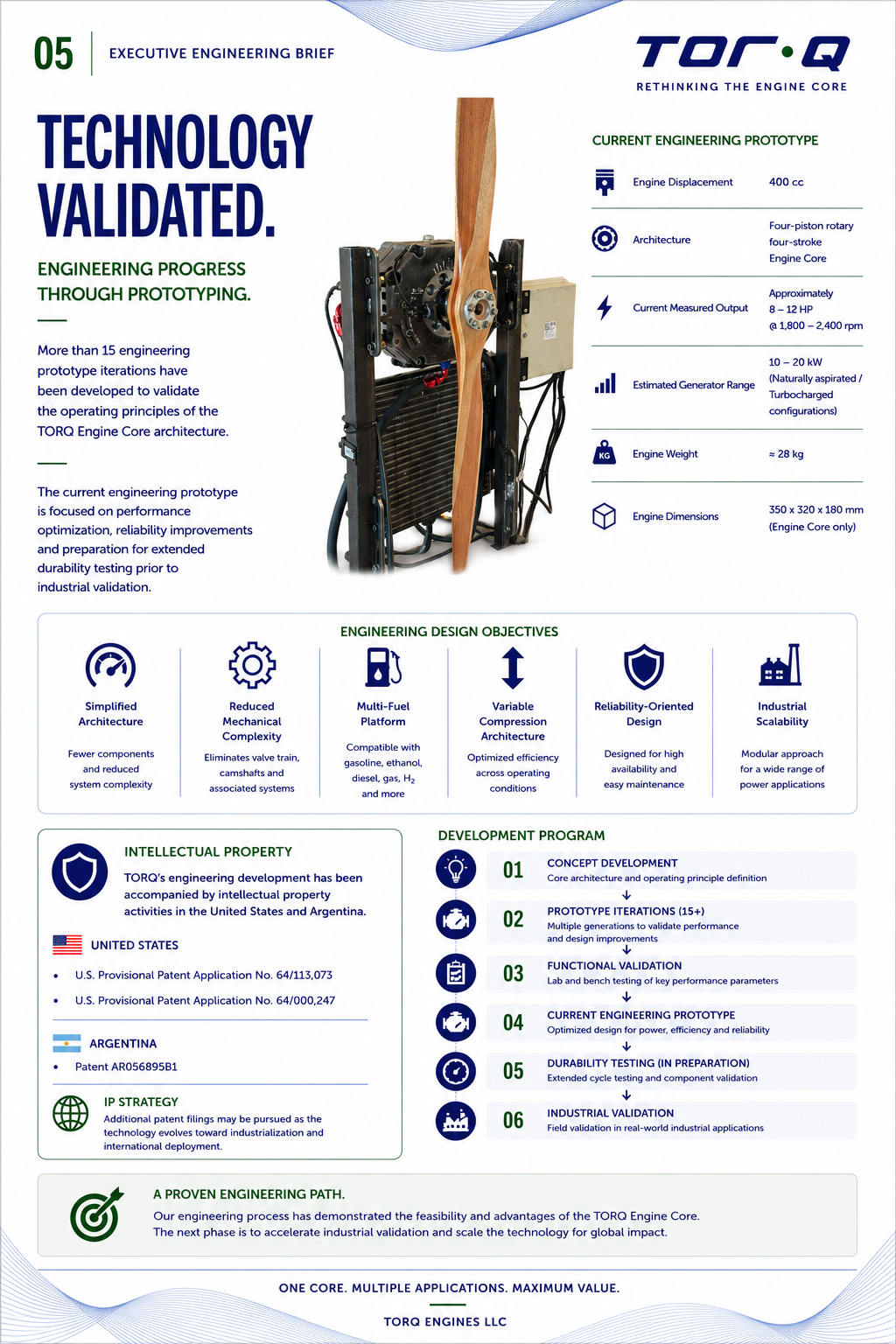
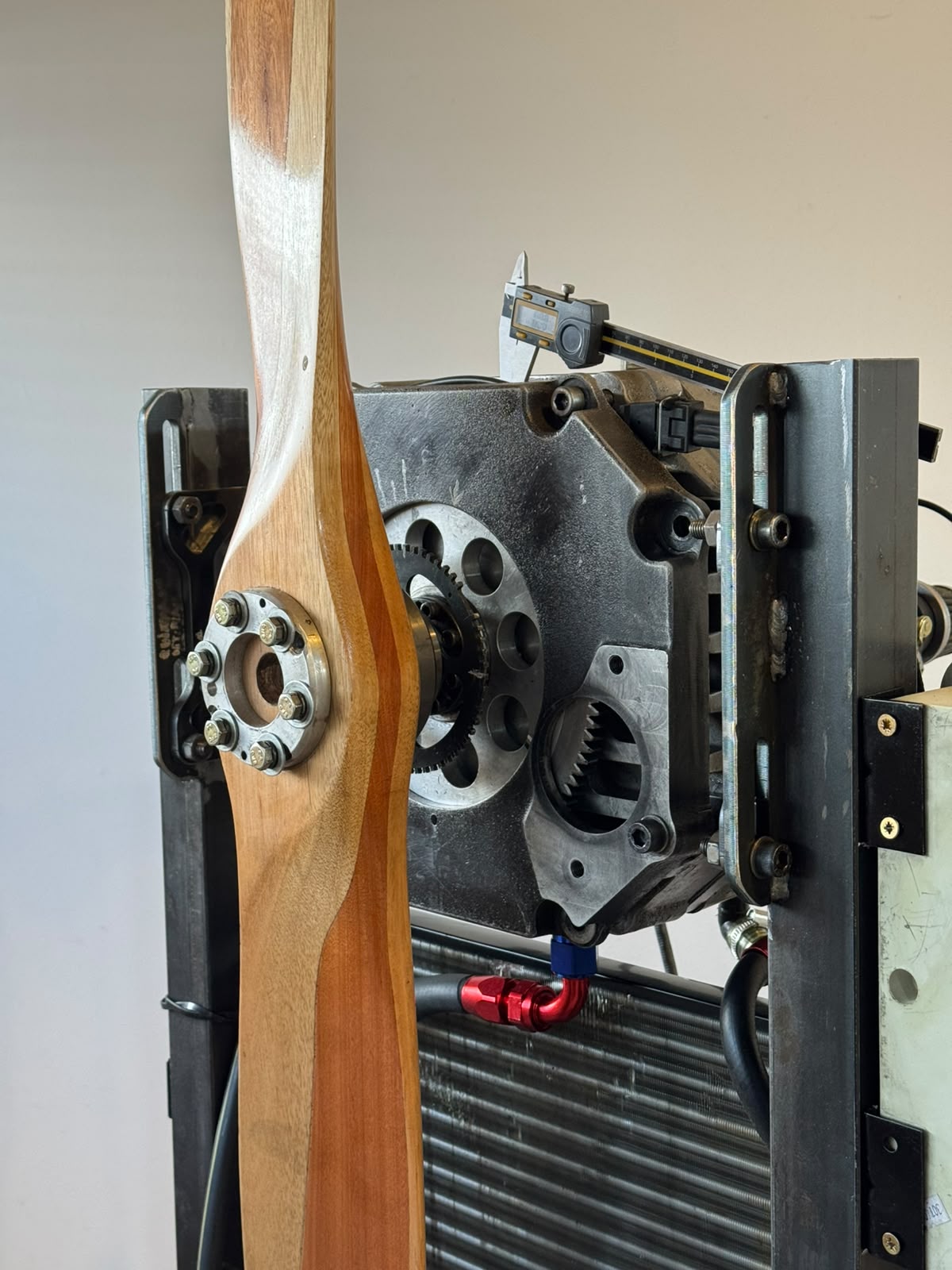
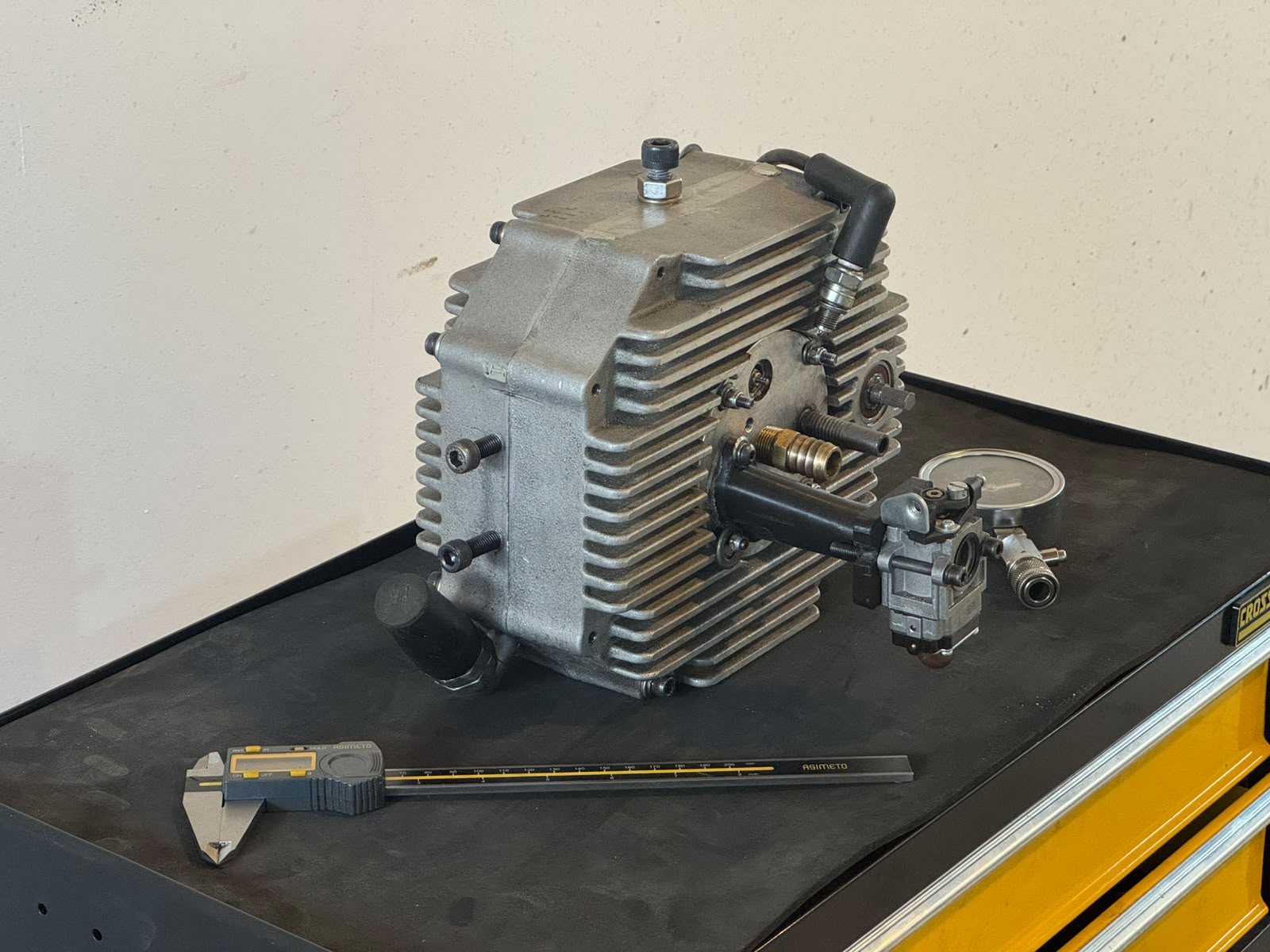
Current engineering prototype
- Engine displacement
- 400 cc
- Architecture
- Four-piston rotary four-stroke Engine Core
- Current measured output
- Approximately 8 – 12 HP @ 1,800 – 2,400 rpm
- Estimated generator range
- 10 – 20 kW (naturally aspirated / turbocharged)
- Engine weight
- ≈ 28 kg
- Engine dimensions
- 350 × 320 × 180 mm (Engine Core only)
Engineering design objectives
Simplified architecture
Fewer components and reduced system complexity.
Reduced mechanical complexity
Eliminates valve train, camshafts and associated systems.
Multi-fuel platform
Compatible with gasoline, ethanol, diesel, gas, H2 and more.
Variable compression architecture
Optimized efficiency across operating conditions.
Reliability-oriented design
Designed for high availability and easy maintenance.
Industrial scalability
Modular approach for a wide range of power applications.
Development program
- 01
Concept development
Core architecture and operating principle definition.
- 02
Prototype iterations (15+)
Multiple generations to validate performance and design improvements.
- 03
Functional validation
Lab and bench testing of key performance parameters.
- 04
Current engineering prototype
Optimized design for power, efficiency and reliability.
- 05
Durability testing (in preparation)
Extended cycle testing and component validation.
- 06
Industrial validation
Field validation in real-world industrial applications.
Intellectual property
TORQ's engineering development has been accompanied by intellectual property activities in the United States and Argentina.
United States
- U.S. Provisional Patent Application No. 64/113,073
- U.S. Provisional Patent Application No. 64/000,247
Argentina
- Patent AR056895B1
IP strategy
Additional patent filings may be pursued as the technology evolves toward industrialization and international deployment.
A proven engineering path.
Our engineering process has demonstrated the feasibility and advantages of the TORQ Engine Core. The next phase is to accelerate industrial validation and scale the technology for global impact.
Evidence — Running hardware
The engine exists. And it runs.
Bench footage, instrumented runs and prototype hardware
- 15+
- Prototype iterations built
- 400 cc
- Current engineering prototype
- 8–12 HP
- Measured @ 1,800–2,400 rpm
- ≈28 kg
- Engine Core weight
Watch it run
Bench run — instrumented test
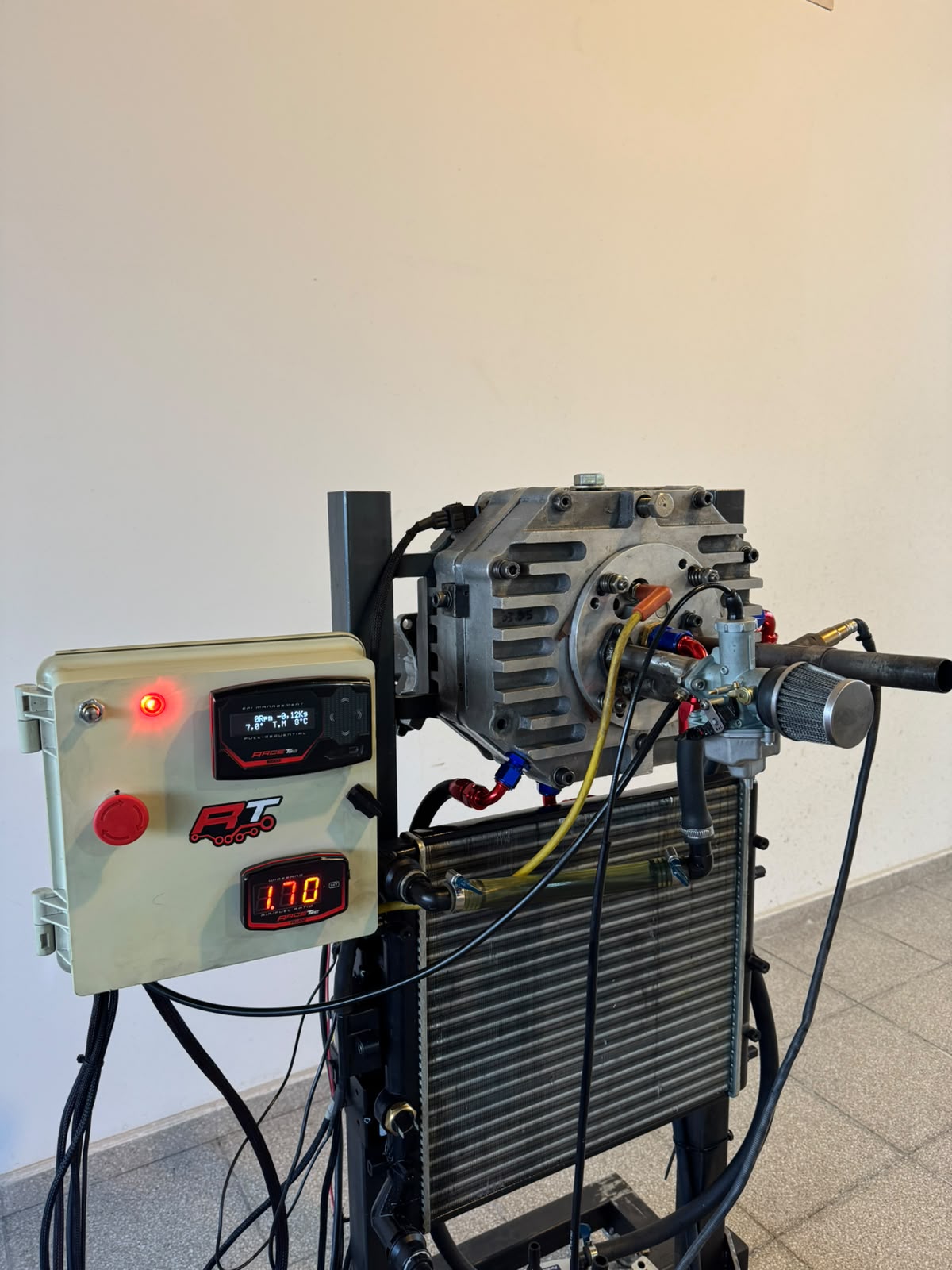
Engine Core running on the test bench with EFI management, wideband air/fuel monitoring and liquid cooling.
A one-minute excerpt of a longer instrumented run. Sensors on intake, exhaust and coolant loops log every cycle so each hardware iteration can be compared against the last.
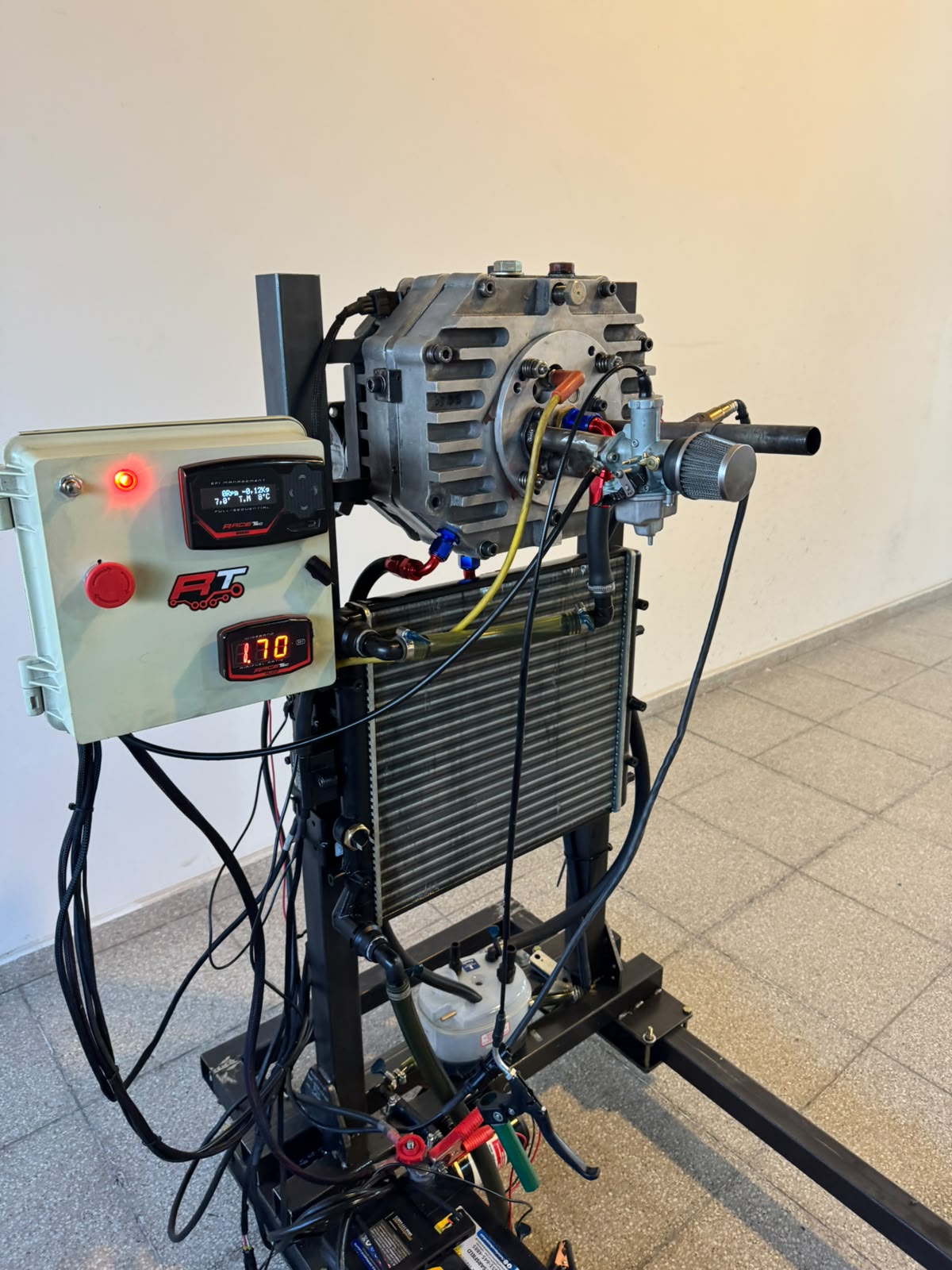
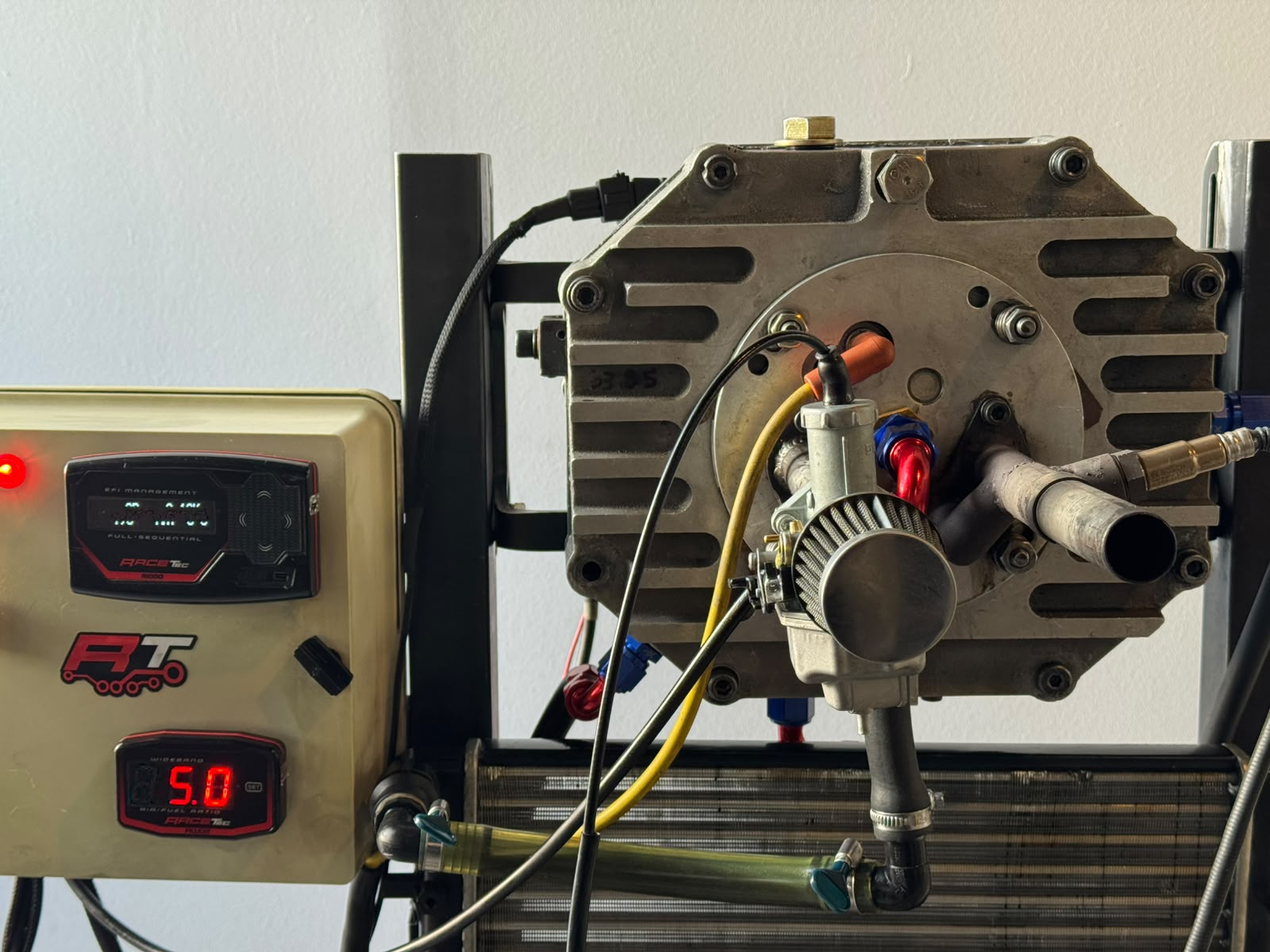
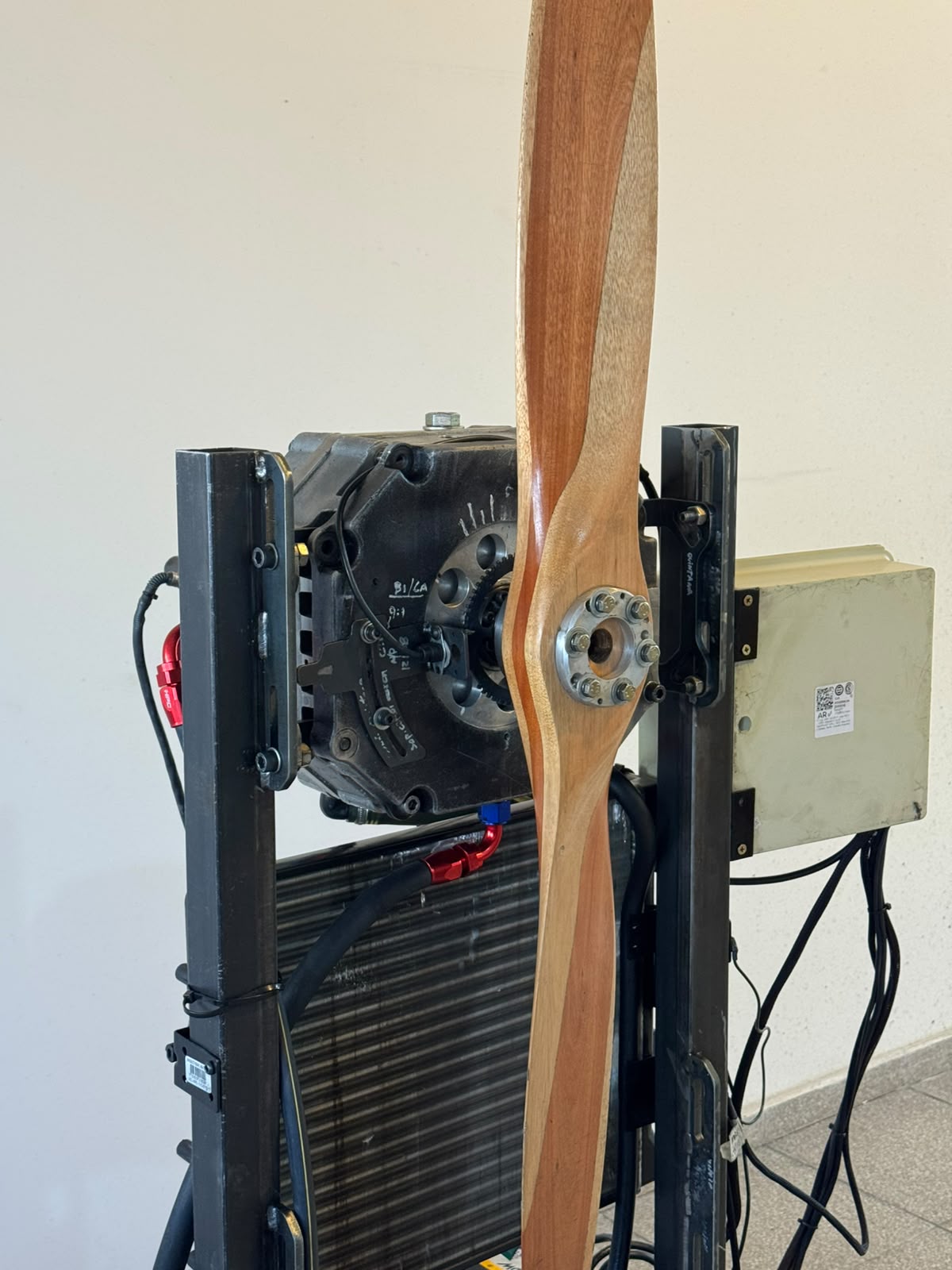
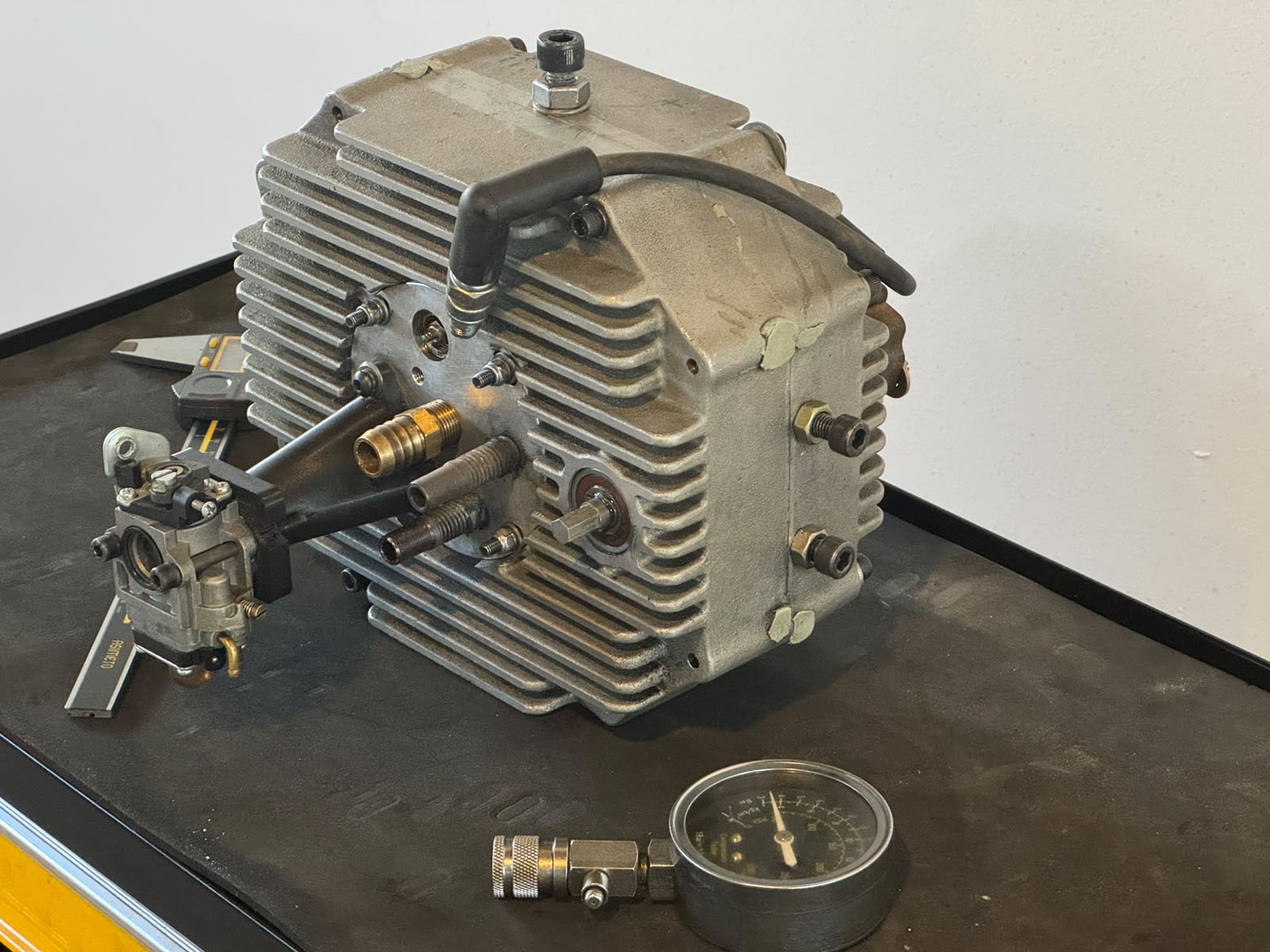
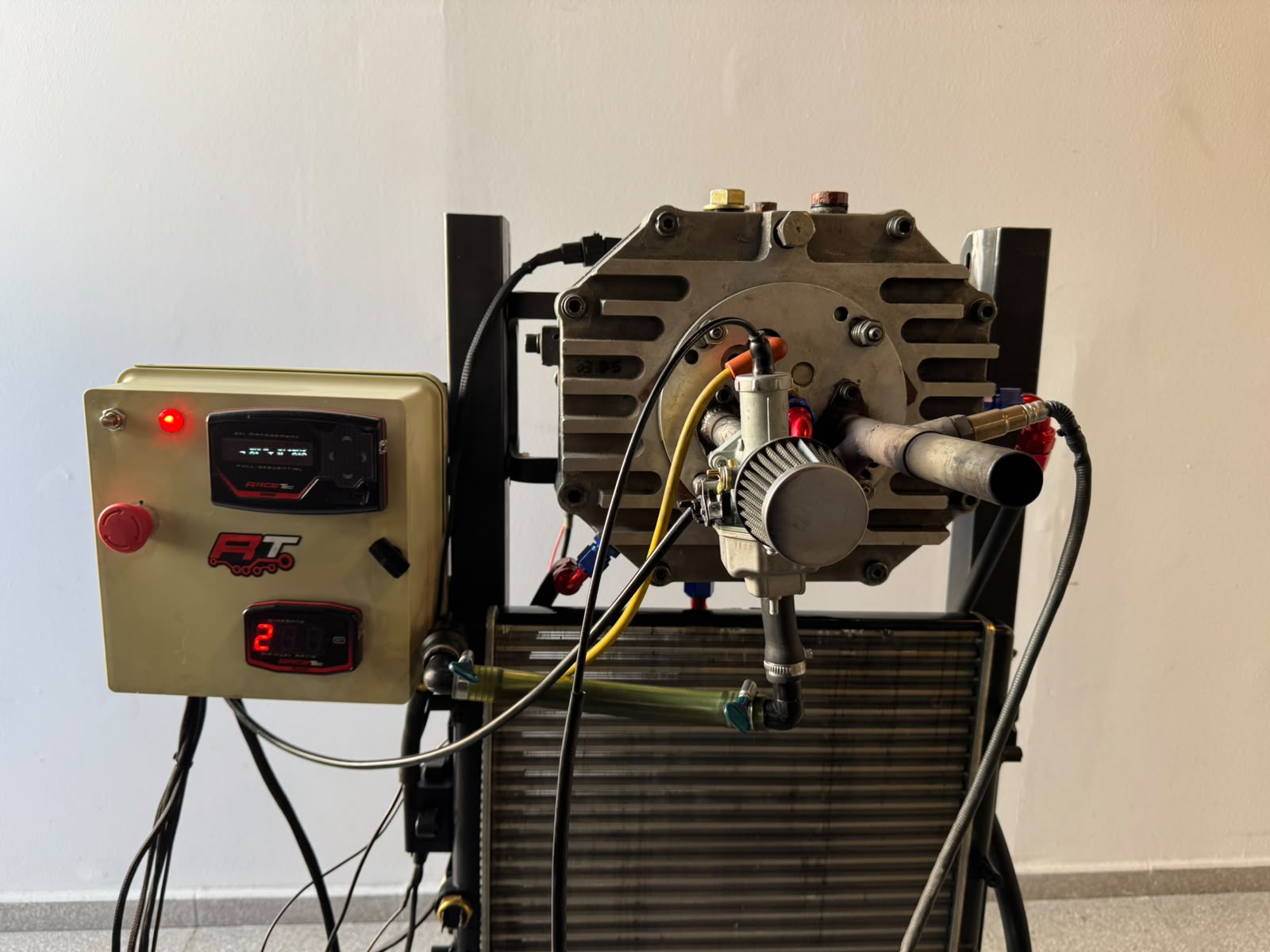
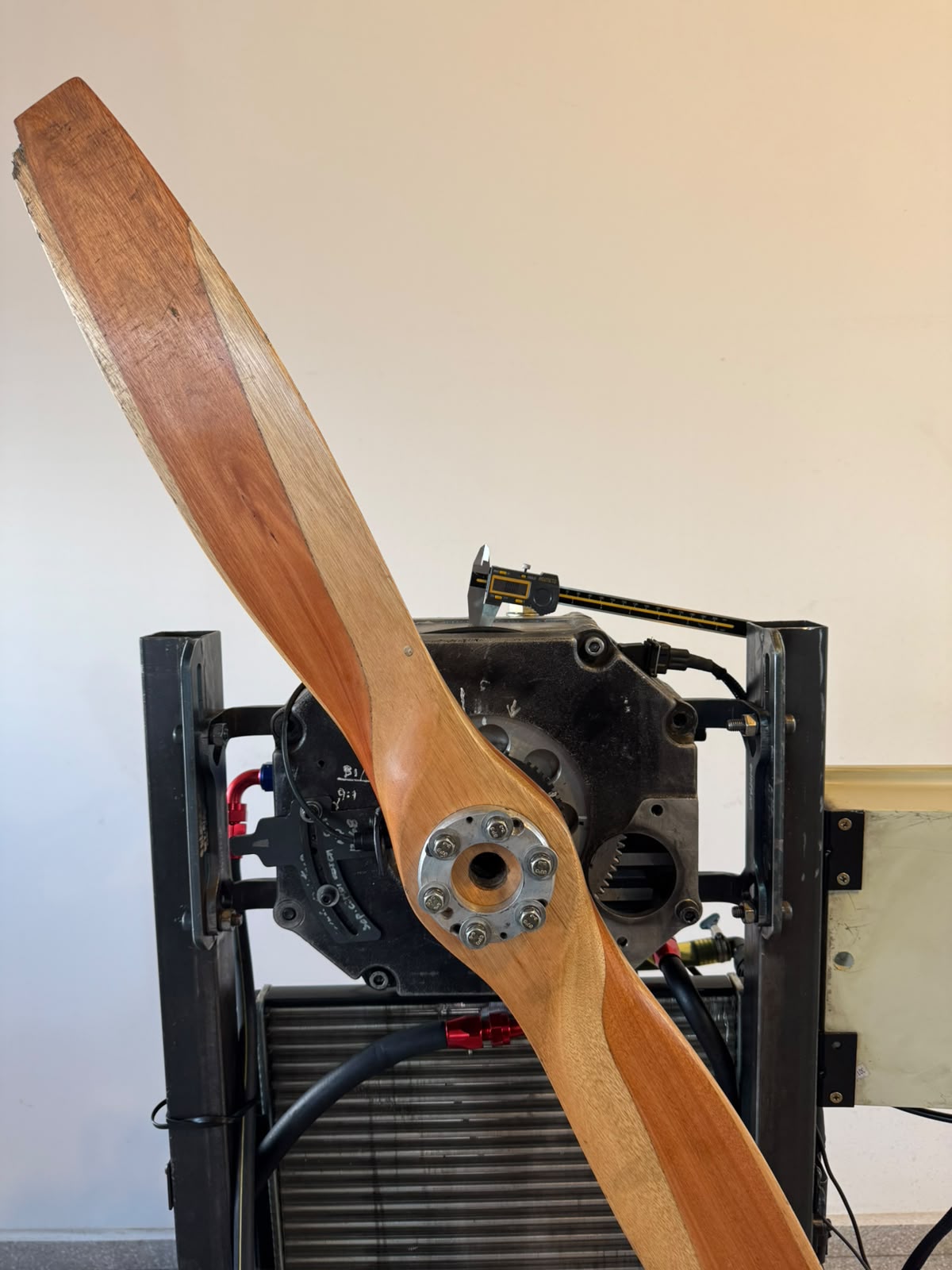
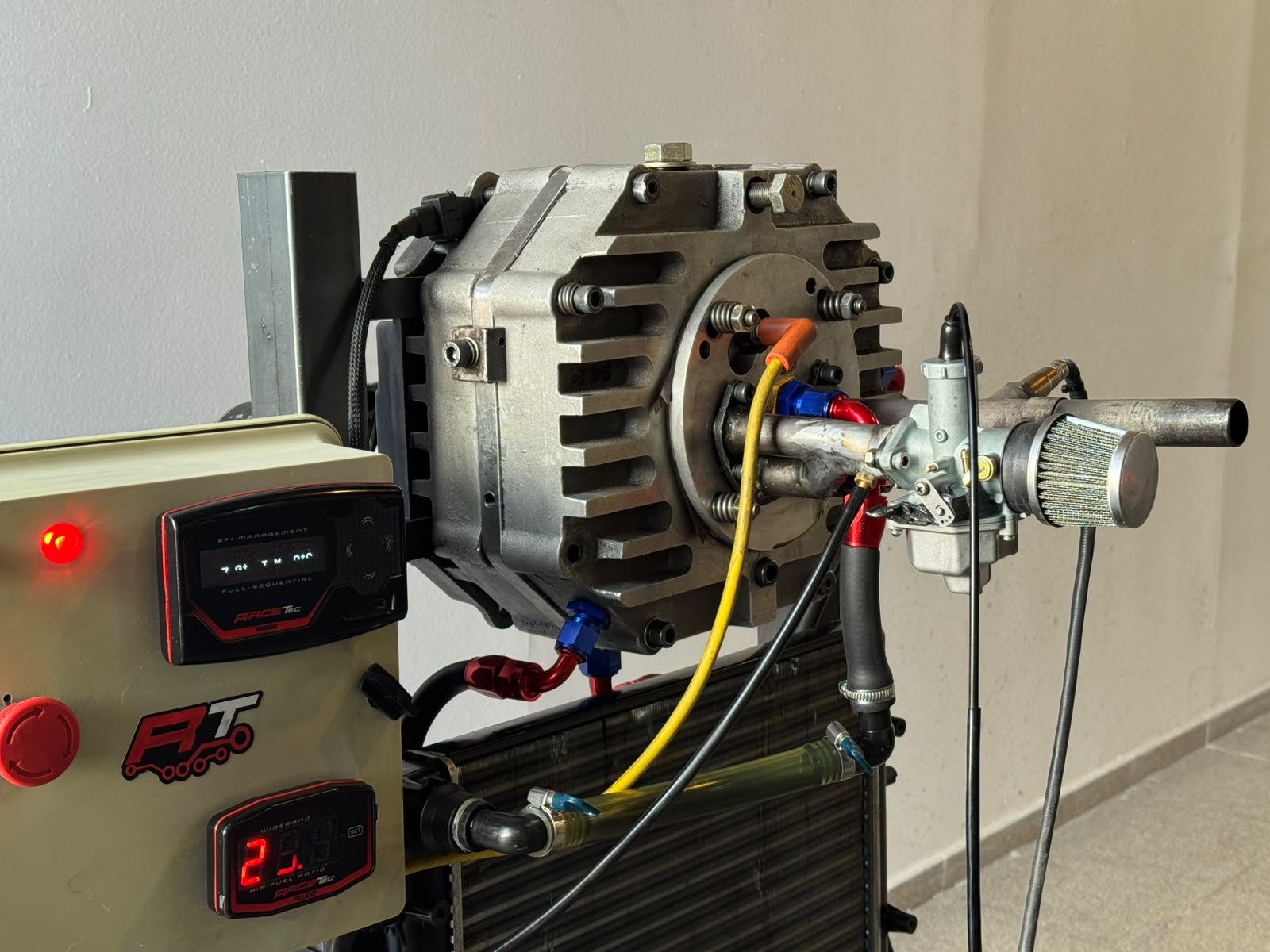
Prototype hardware, photographed
The 400 cc engineering prototype, its instrumented test bench and the bare Engine Core out of the rig.
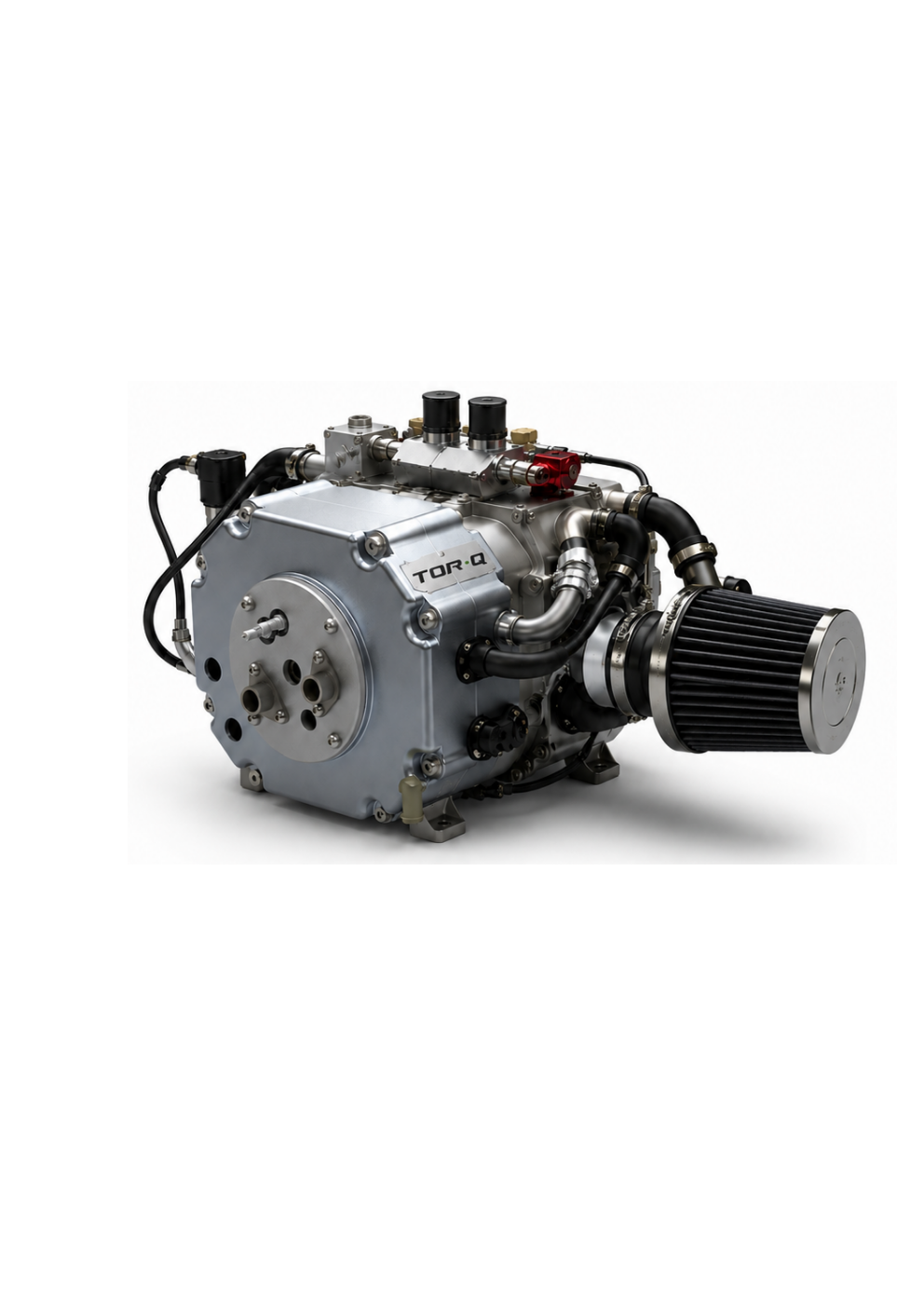
Industrial configuration study
Photography and footage of the current engineering prototype. No renders, no simulations.
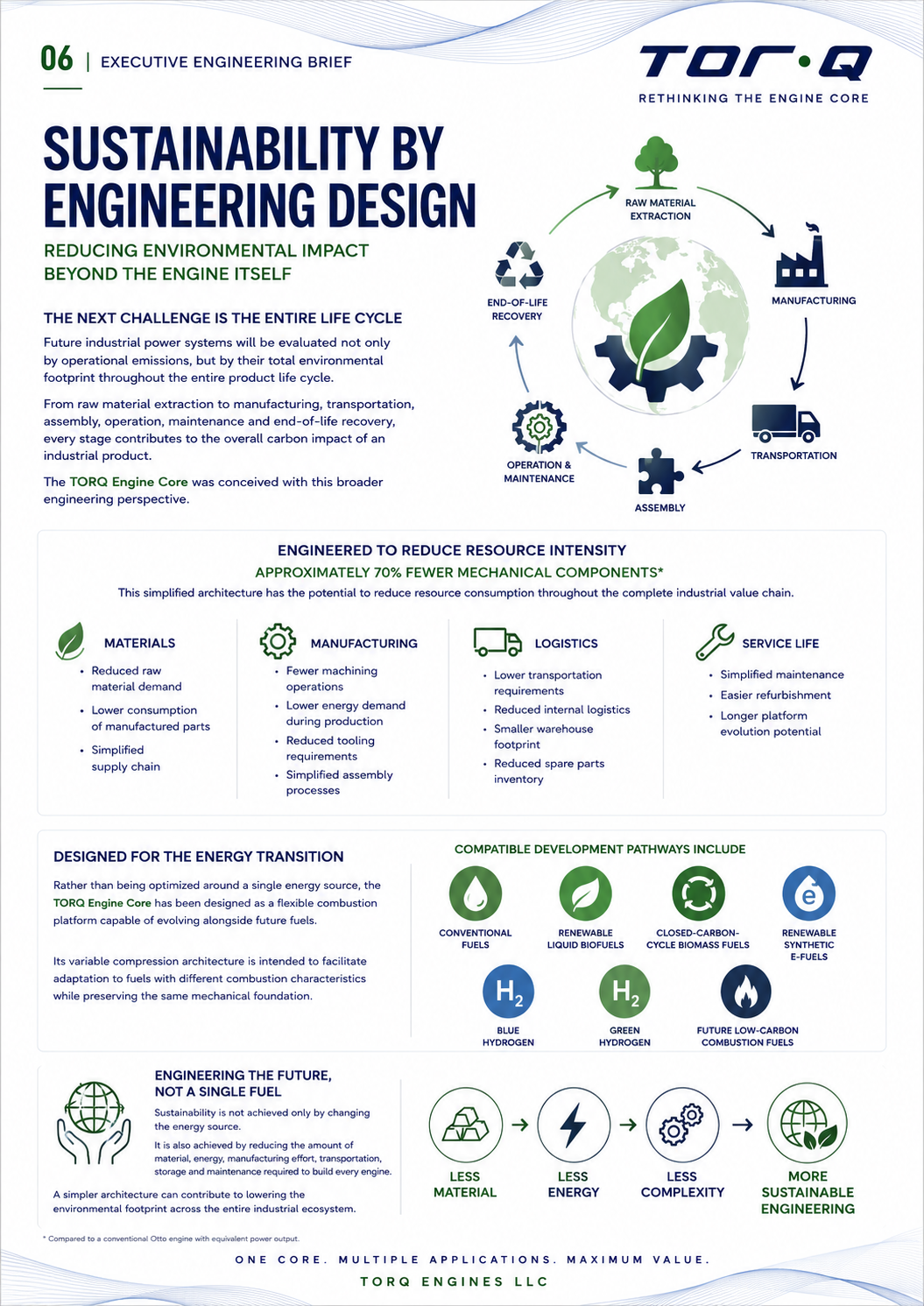
06 — Sustainability by engineering design
Sustainability by engineering design
Reducing environmental impact beyond the engine itself
The next challenge is the entire life cycle
Future industrial power systems will be evaluated not only by operational emissions, but by their total environmental footprint throughout the entire product life cycle.
From raw material extraction to manufacturing, transportation, assembly, operation, maintenance and end-of-life recovery, every stage contributes to the overall carbon impact of an industrial product.
The TORQ Engine Core was conceived with this broader engineering perspective.
- 01Raw material extraction
- 02Manufacturing
- 03Transportation
- 04Assembly
- 05Operation & maintenance
- 06End-of-life recovery
Engineered to reduce resource intensity
Approximately 70% fewer mechanical components*
This simplified architecture has the potential to reduce resource consumption throughout the complete industrial value chain.
Materials
- Reduced raw material demand
- Lower consumption of manufactured parts
- Simplified supply chain
Manufacturing
- Fewer machining operations
- Lower energy demand during production
- Reduced tooling requirements
- Simplified assembly processes
Logistics
- Lower transportation requirements
- Reduced internal logistics
- Smaller warehouse footprint
- Reduced spare parts inventory
Service life
- Simplified maintenance
- Easier refurbishment
- Longer platform evolution potential
Designed for the energy transition
Rather than being optimized around a single energy source, the TORQ Engine Core has been designed as a flexible combustion platform capable of evolving alongside future fuels.
Its variable compression architecture is intended to facilitate adaptation to fuels with different combustion characteristics while preserving the same mechanical foundation.
Compatible development pathways include
- Conventional fuels
- Renewable liquid biofuels
- Closed-carbon-cycle biomass fuels
- Renewable synthetic e-fuels
- Blue hydrogen
- Green hydrogen
- Future low-carbon combustion fuels
Engineering the future, not a single fuel
Sustainability is not achieved only by changing the energy source.
It is also achieved by reducing the amount of material, energy, manufacturing effort, transportation, storage and maintenance required to build every engine.
A simpler architecture can contribute to lowering the environmental footprint across the entire industrial ecosystem.
- Less material
- Less energy
- Less complexity
- More sustainable engineering
* Compared to a conventional Otto engine with equivalent power output.
07 — Building the future of industrial power
Building the future of industrial power
A platform designed for strategic partnerships
The engineering concept has been demonstrated through successive prototype generations.
The next phase is to accelerate industrial validation, manufacturing optimization and global deployment through partnerships with organizations that share a long-term vision for advanced industrial power systems.
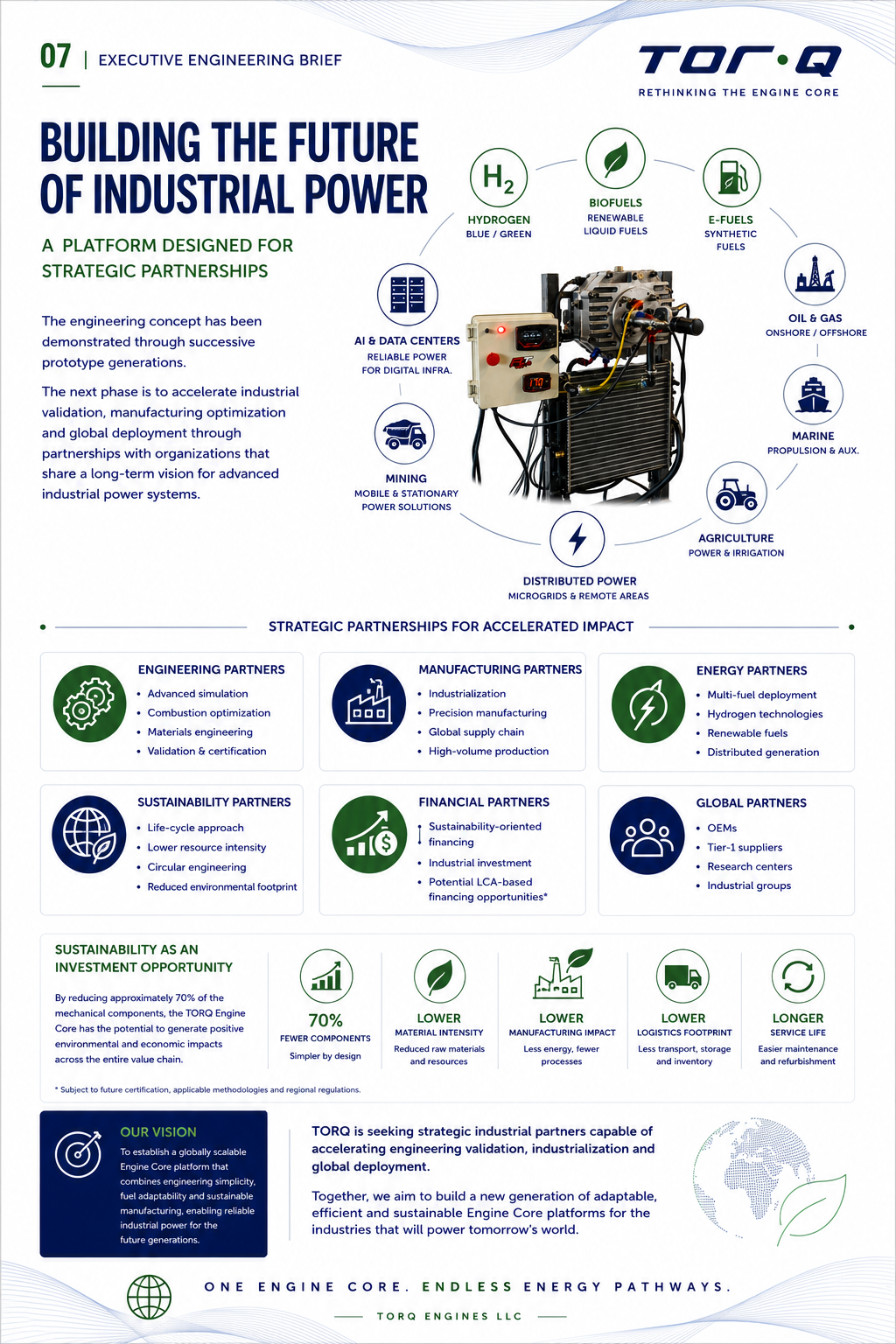
One Engine Core. Endless energy pathways.
Hydrogen
Blue / green
Biofuels
Renewable liquid fuels
E-fuels
Synthetic fuels
Oil & gas
Onshore / offshore
Marine
Propulsion & auxiliary
Agriculture
Power & irrigation
Distributed power
Microgrids & remote areas
Mining
Mobile & stationary power
AI & data centers
Reliable power for digital infra.
Strategic partnerships for accelerated impact
Engineering partners
- Advanced simulation
- Combustion optimization
- Materials engineering
- Validation & certification
Manufacturing partners
- Industrialization
- Precision manufacturing
- Global supply chain
- High-volume production
Energy partners
- Multi-fuel deployment
- Hydrogen technologies
- Renewable fuels
- Distributed generation
Sustainability partners
- Life-cycle approach
- Lower resource intensity
- Circular engineering
- Reduced environmental footprint
Financial partners
- Sustainability-oriented financing
- Industrial investment
- Potential LCA-based financing opportunities*
Global partners
- OEMs
- Tier-1 suppliers
- Research centers
- Industrial groups
Sustainability as an investment opportunity
By reducing approximately 70% of the mechanical components, the TORQ Engine Core has the potential to generate positive environmental and economic impacts across the entire value chain.
- 70%
Fewer components
Simpler by design
- Lower
Material intensity
Reduced raw materials and resources
- Lower
Manufacturing impact
Less energy, fewer processes
- Lower
Logistics footprint
Less transport, storage and inventory
- Longer
Service life
Easier maintenance and refurbishment
* Subject to future certification, applicable methodologies and regional regulations.
Our vision
To establish a globally scalable Engine Core platform that combines engineering simplicity, fuel adaptability and sustainable manufacturing, enabling reliable industrial power for the future generations.
TORQ is seeking strategic industrial partners capable of accelerating engineering validation, industrialization and global deployment.
Together, we aim to build a new generation of adaptable, efficient and sustainable Engine Core platforms for the industries that will power tomorrow's world.
Executive engineering brief
The complete seven-page brief covering architecture, validation, sustainability and partnership opportunities.
Contact
Let's engineer the next industrial power platform
For technical documentation, partnership discussions or evaluation programs, our engineering team is available.
Contact information
- german@torq-engines.com
- +54 9 3515076105
- Cordoba, Argentina
Request information
Technical documentation and partnership material available on request.